
Why Hearing Matters for Both Thinking and Walking as We Age
If you’ve read my previous blog post on how hearing loss impacts brain aging, you’ll know that hearing plays a much bigger role in brain health than we often realize. (blog post by Dr Downey)
In my latest research, I explored how hearing affects our ability to walk and think at the same time—something we do constantly in everyday life.
In neuropsychology, this is called dual-tasking. It’s what allows us to walk while having a conversation, plan our next steps, or navigate busy environments safely.
What we found
We studied older adults with mild cognitive impairment over a 20-week program that involved different combinations of physical exercise and cognitive training. What we found was striking.
Participants with poorer hearing had more difficulty with dual-tasking. Specifically, their walking was more variable from one step to the next, a marker of poor stability. These effects were even stronger in individuals who also had lower cognitive performance and in male participants.
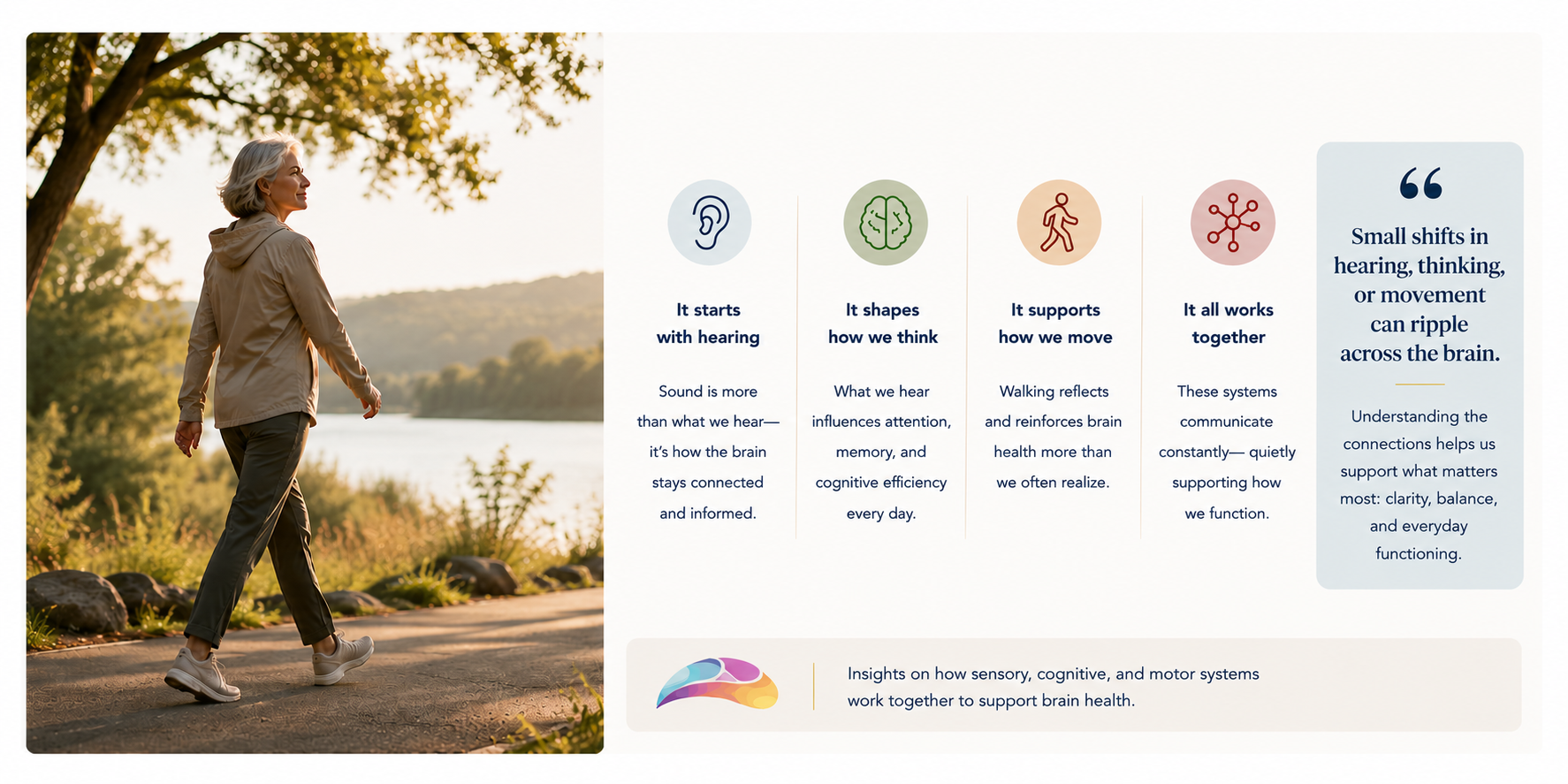
This reinforces something I often explain to clients: the brain doesn’t work in isolated systems. Hearing, thinking, and movement are deeply interconnected.
The hopeful part
What I find most encouraging about this research is that these challenges are not fixed.
Participants who completed multi-component physical exercise and cognitive training showed meaningful improvements in their ability to walk and think at the same time, and even more so in older adults with a greater degree of hearing loss.
This speaks to something I emphasize often in my practice: the brain remains adaptable, even in the presence of cognitive or sensory changes.
What this means for you
If you’ve noticed changes in hearing, balance, or multi-tasking, it’s worth paying attention. These can be early signs of how different brain systems are interacting—not isolated issues.
If you’d like to better understand your cognitive health or how factors like hearing may be affecting your day-to-day functioning, feel free to reach out to book an assessment or consultation.
Further reading:
- Concordia summary: https://www.concordia.ca/news/stories/2026/04/07/hearing-loss-makes-it-harder-for-cognitively-impaired-older-adults-to-walk-and-think-simultaneously.html
- Full research article (Frontiers in Aging Neuroscience): https://pmc.ncbi.nlm.nih.gov/articles/PMC12901436/
Blog post by Rachel Downey. Below her schedule, to book with her.
