Intervention in neuropsychology - different approaches
Like psychotherapy, cognitive interventions include a variety of approaches and strategies. While all these interventions focus on improving cognitive functioning, different programs use distinct methods and pursue different goals. Scientific literature reviews suggest 3 main types of cognitive intervention (Linda Clare & Woods, 2004) :
-
Cognitive Stimulation involves general mental and social activation through activities such as conversations, games, or quizzes. The goal is to enhance overall cognitive and social functioning. This approach does not necessarily aim to improve your awareness of your own thinking processes (known as metacognition) and can often be used independently without a therapist (Aguirre, Woods, Spector, & Orrell, 2013; Clare & Woods, 2004).
-
Cognitive Training focuses on maintaining or improving specific cognitive skills like attention or memory through guided practice and repetition of standardized tasks (Kasper et al., 2015).
-
Cognitive Rehabilitation aims to help you maintain or improve everyday functioning by teaching compensatory strategies. These can include adapting your environment or using external aids such as automatic reminders. This approach is usually personalized, though it can also be offered in group settings—as is done, for example, at the Douglas Institute (Huckans et al., 2013; Storzbach et al., 2016; Twamley et al., 2014, 2015).
Intervention for adults with ADHD
For Adults Facing Challenges with Organization, Prioritization, and Procrastination
Many adults who struggle with organizational skills, time management, and procrastination also experience mood disturbances related to these difficulties. While medication can improve focus, it typically has little to no effect on organizational abilities. Research supports that the most effective treatment for adult ADHD combines medication with targeted behavioral interventions (Biderman et al., 1996; Wender et al., 1998; Wilens et al., 1998).
Dr. Geneviève Gagnon provides personalized, evidence-based cognitive-behavioral interventions designed to empower adults to regain control over their daily lives. Drawing on the latest research in executive functioning and executive coaching, these interventions help patients develop practical strategies to become more proactive, improve self-awareness, and enhance their overall functioning.
This program (book available here on amazon!) is offered individually over 10 to 13 sessions, typically scheduled every 2 weeks. To schedule a consultation, please book here.
For complaints including:
- Feeling overwhelmed at work
- Running late on projects
- Memory / Attention mistakes
- Difficulty Multi-tasking/Prioritizing
- Procrastination
Intervention for adults with Subjective Memory complaints
The Synapse Program: Enhancing Cognitive Functioning
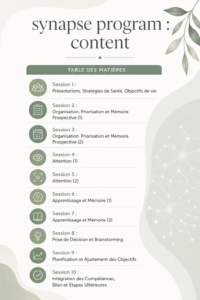
The Synapse program is designed to help individuals experiencing subjective cognitive difficulties improve key functions such as memory, attention, and organization in everyday life. Because our approach is integrative and tailored to your unique needs, the program can be delivered either in full or in selected components, depending on what suits you best.
Synapse is adapted from the Compensatory Cognitive Training (CCT) program originally developed in the United States by Dr. Elizabeth W. Twamley (University of California, San Diego) and Marilyn Huckans (Oregon Health & Science University). This evidence-based program was initially validated in the U.S. (Storzbach et al., 2016). We are proud to offer this program in Quebec, having translated and culturally adapted it for the local population (2015-2016). This work was led by Dr. Marjolaine Masson, a neuropsychologist and former postdoctoral trainee, in collaboration with her then research supervisor, Dr. Geneviève Gagnon. The Synapse program is currently offered at the Douglas Mental Health University Institute, where it is delivered by Nancy Grenier, Occupational Therapist, and Lisa O'Reilly, Recreational Therapist. The program was initially developed and overseen as a research project by Dr. Geneviève Gagnon during her time as a researcher. It is now competently led and provided by these two experienced clinicians. Additionally, the program is offered in Salaberry-de-Valleyfield, Montérégie-Ouest (CISSS Montérégie-Ouest) by local professionals trained at the Douglas Institute under the supervision of Dr. Gagnon and Dr. Masson.
The program is also offered by Dr. Gagnon and typically includes 10–13 individual sessions scheduled every 2–3 weeks. Remote sessions are available when appropriate.
For complaints including:
- Subjective memory change
- Difficulty Memorizing new information
- Questions about cognitive aging
- Difficulty adjusting to cognitive changes